Downtime Energy Consumption: Why Stopped Equipment Still Costs Money
Downtime energy consumption happens when idle machines, utilities, compressors, HVAC, pumps, and support systems keep consuming power even when production is not running.
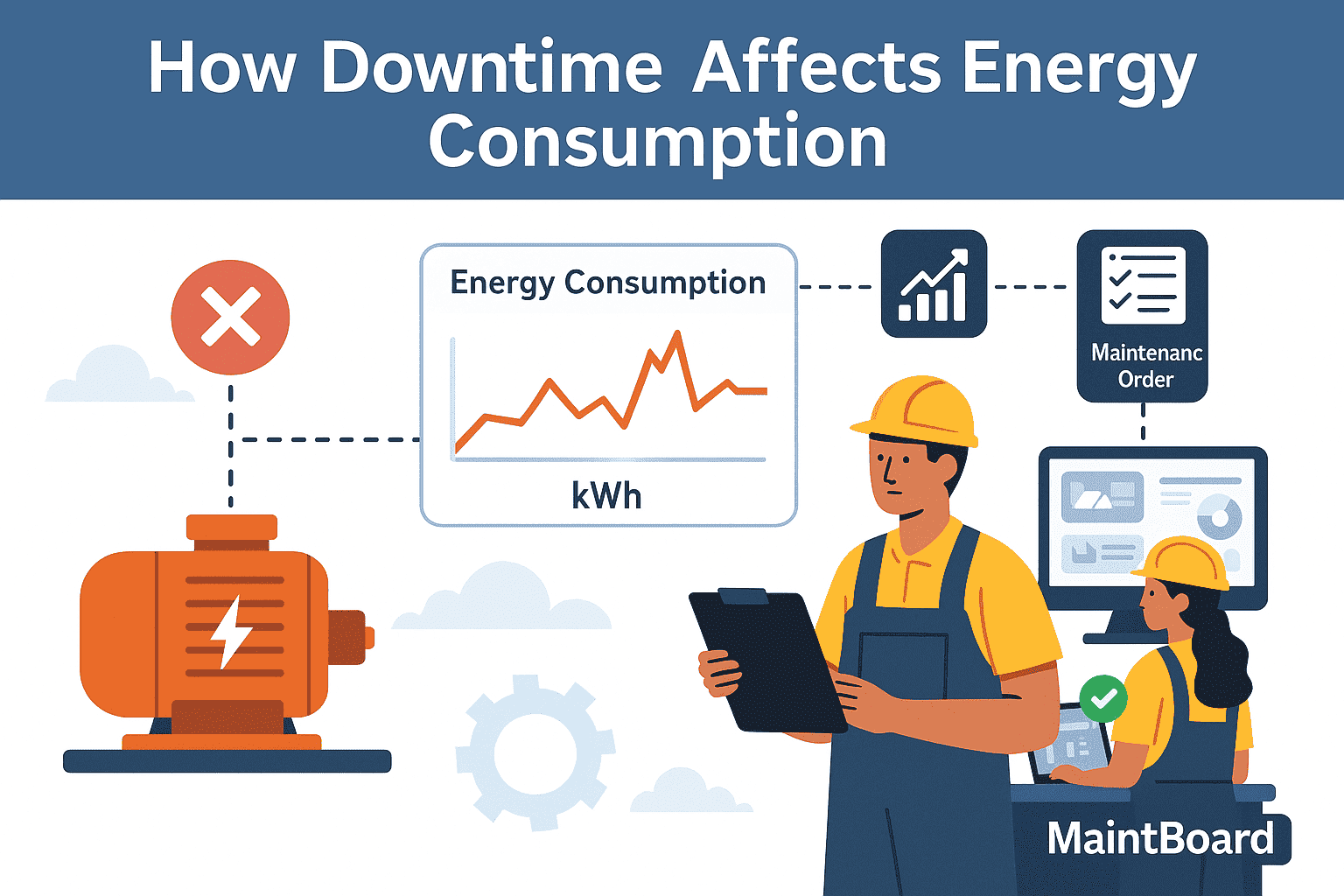
Downtime does not always mean energy consumption stops. In many plants, equipment is not producing, but utilities, compressors, pumps, HVAC, conveyors, heaters, chillers, lighting, and support systems continue to consume power.
This is why downtime energy consumption matters. A stopped line can still create energy cost, especially when maintenance, production, and utility teams do not have clear visibility.
What is downtime energy consumption?
Downtime energy consumption is the energy used while production output is stopped, reduced, waiting, blocked, or idle.
Examples:
- Compressor runs while the line is stopped.
- HVAC continues at full load during non-production periods.
- Pumps circulate when process demand is low.
- Motors idle between production runs.
- Conveyors run without material.
- Chillers operate while downstream equipment is unavailable.
- Lighting remains on in unused areas.
- Machine warm-up energy is wasted due to repeated stoppages.
The machine may not be producing value, but the meter keeps moving.
Why maintenance teams should care
Energy waste is not only an energy department issue. Maintenance has strong influence over energy performance because equipment condition affects consumption.
Poor maintenance can cause:
- Air leaks
- Steam leaks
- Pump inefficiency
- Motor overheating
- Dirty filters
- Poor lubrication
- Misalignment
- Excessive friction
- Poor HVAC performance
- Compressor cycling issues
- Cooling system inefficiency
A machine can be “running” and still be wasting energy because it is not maintained properly.
Downtime creates double loss
When downtime occurs, the plant may lose twice:
- Production output is lost.
- Energy continues to be consumed.
This is especially painful when support utilities keep running during stoppages.
For example, a packaging line may stop because of a mechanical issue, but compressed air, HVAC, conveyors, lighting, and upstream or downstream equipment may remain active. The energy cost continues even though saleable output is zero.
Common causes of idle energy waste
Common causes include:
- No shutdown checklist during long stoppages
- Operators unsure what can be switched off
- Utilities not linked to production status
- Poor communication between maintenance and production
- Breakdown work delays
- Repeated short stoppages
- Equipment left running after trials
- Manual restart fears
- Lack of meter-level visibility
Many of these are process problems, not technology problems.
Maintenance data needed to understand the issue
To connect downtime and energy, teams need both maintenance and energy data.
Useful maintenance data includes:
- Breakdown start and end time
- Asset affected
- Work order status
- Delay reason
- Production area
- Cause of stoppage
- Repair duration
- Follow-up action
Useful energy data includes:
- Meter readings
- Energy consumption by area or asset group
- Peak demand
- Idle consumption
- Utility load during stoppage
- Compressor or HVAC consumption trends
A energy monitoring software workflow becomes more useful when connected with maintenance events.
What maintenance can do immediately
Maintenance teams can reduce downtime energy waste with practical actions.
Start with:
- Identify high-energy assets and utilities.
- Review energy use during known downtime periods.
- Create shutdown checklists for long stoppages.
- Fix compressed air leaks.
- Maintain filters, belts, motors, pumps, and HVAC assets.
- Record delay reasons in work orders.
- Review repeated breakdowns on energy-intensive lines.
- Plan PMs for assets that create energy loss when inefficient.
A preventive maintenance software process can help schedule checks that protect both reliability and energy performance.
Use work orders to capture delay reasons
Energy waste during downtime often increases because the downtime lasts longer than necessary. Work orders should capture why a job is delayed.
Common delay reasons:
- Waiting for spare parts
- Waiting for technician
- Waiting for vendor
- Waiting for production access
- Waiting for approval
- Waiting for testing
- Waiting for permit
A work order management software process helps expose where time is lost. Reducing delay also reduces unnecessary energy consumption during stoppages.
Create shutdown and restart checklists
For planned downtime or long stoppages, create clear checklists.
Checklist items may include:
- What can be safely switched off
- What must remain running
- Who authorizes shutdown
- Utility isolation requirements
- Restart sequence
- Safety checks
- Product quality checks
- Communication responsibility
This prevents unsafe shutdowns while reducing unnecessary load.
Reports managers should review
Useful reports include:
- Downtime hours by asset
- Energy consumption during downtime
- Repeated breakdowns on high-energy assets
- Idle energy by area
- PM compliance for energy-critical assets
- Compressed air leak work orders
- HVAC maintenance completion
- Work order delay reasons
A analytics and reporting software setup can help connect maintenance execution with energy performance.
Bottom line
Downtime energy consumption is a hidden cost. A stopped line may still consume energy through utilities, idle equipment, HVAC, compressors, pumps, and support systems.
Maintenance teams can reduce this waste by improving equipment condition, recording downtime accurately, fixing repeated failures, reducing repair delays, and creating clear shutdown practices.
The strongest approach is to connect energy monitoring with CMMS work orders, PMs, asset history, and reports so the plant can see not only where energy is used, but why it is being wasted.
Frequently asked questions
- Do all machines consume energy during downtime?
Most do—especially those with standby systems, thermal controls, or safety loops.
- Can CMMS help reduce this loss?
Yes. When energy meters are integrated, CMMS can trigger alerts and auto-shutdowns.
- Is this relevant for low-power assets?
Yes. Cumulative waste across many low-load assets adds up over time.
- Should we include downtime energy loss in our ROI calculations?
Absolutely. Failing to include this hidden cost leads to underestimating the true cost of equipment failure.
- How do we justify the cost of energy meters?
Start with your most energy-intensive assets. The ROI often becomes visible within months when tied to downtime reduction.
- Can we track downtime-related carbon emissions?
Yes. With kWh and emission factor data, CMMS can help track Scope 2 emissions linked to downtime.