Energy Monitoring in Maintenance: What to Track, Why It Matters, and Where CMMS Fits
Energy waste often points to maintenance problems such as leaks, worn parts, misalignment, and poor operating conditions. Learn what maintenance teams should monitor.
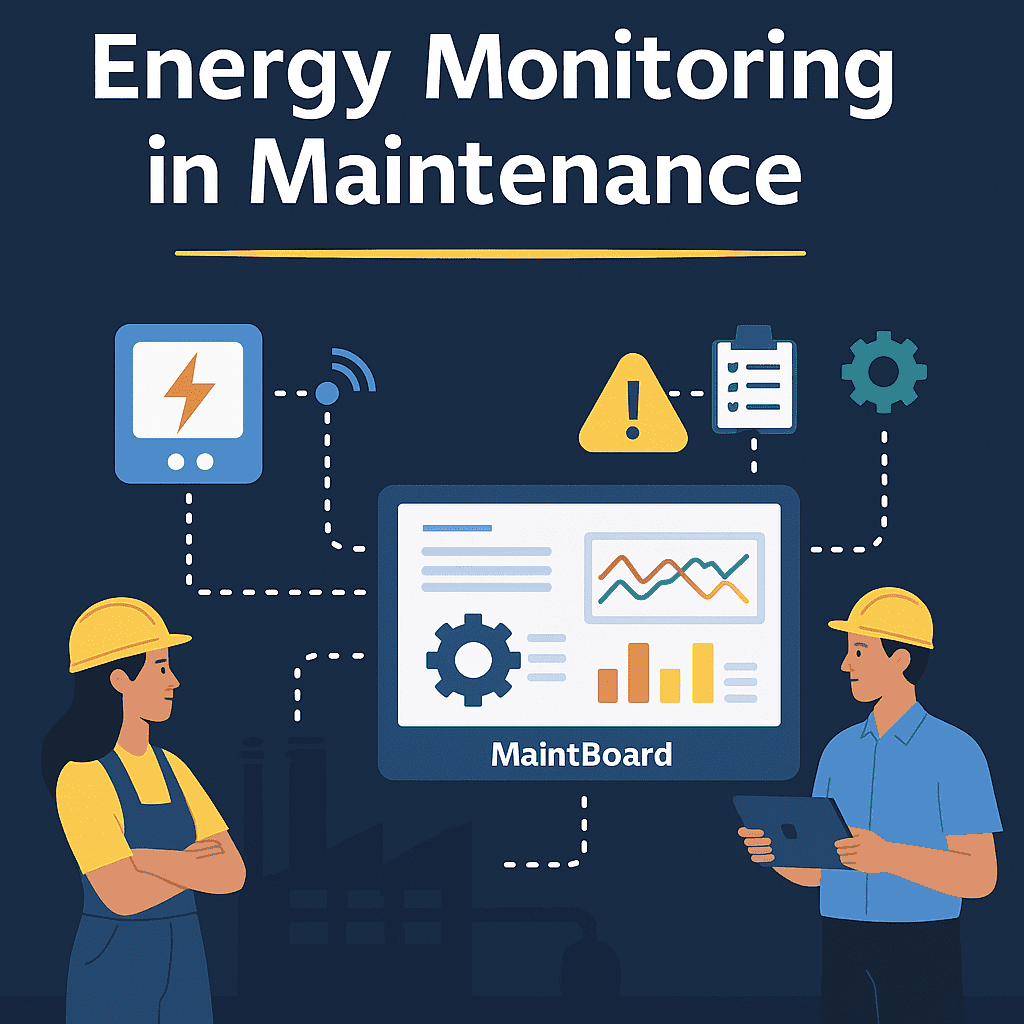
Energy monitoring is often treated as a utility or sustainability topic. In a plant, it is also a maintenance topic.
A machine that consumes more energy than normal may be overloaded, misaligned, leaking, poorly lubricated, or running in an unstable condition. Energy data can help maintenance teams find hidden problems before they become breakdowns or high-cost failures.
The value comes when energy monitoring is connected to maintenance action through energy monitoring software, work orders, inspections, and asset history.
Why maintenance teams should care about energy
Energy waste is not always caused by production volume. It can also come from equipment condition.
Examples include:
- Compressed air leaks
- Steam trap failures
- Worn bearings
- Poor lubrication
- Misaligned motors
- Dirty filters
- Overloaded pumps
- Inefficient chillers
- Motors running idle
- Machines left on during downtime
These are maintenance problems. If they are not tracked, the plant pays for them every month.
Energy monitoring is not only meter reading
Many teams think energy monitoring means collecting meter values. That is only the first step.
Useful energy monitoring answers questions like:
- Which asset is consuming more than normal?
- Did energy use increase after a repair?
- Is idle energy consumption too high?
- Which area has abnormal consumption during non-production hours?
- Does a machine consume more energy before failure?
- Did a maintenance action reduce consumption?
This is where energy data becomes useful for reliability and cost control.
What maintenance teams should track
The exact data depends on the plant, but common useful readings include:
- Electricity consumption
- Motor current
- Power factor
- Compressed air flow
- Steam usage
- Water usage
- Chilled water consumption
- Fuel usage
- Temperature and pressure trends
- Runtime hours
For many plants, the best starting point is not advanced AI. It is consistent reading history and simple trend visibility.
Connect energy readings to assets
Energy data becomes more useful when it is connected to assets.
For example, instead of seeing only plant-level electricity consumption, the team should be able to see that a compressor, chiller, pump, oven, or production line is behaving differently from its normal pattern.
That requires a clean asset structure inside asset management software. If the asset hierarchy is unclear, energy trends become difficult to interpret.
Look for abnormal trends, not only high consumption
High consumption is not always bad. A machine running at full production may naturally consume more.
Maintenance teams should look for abnormal patterns:
- Energy use increasing for the same output
- Energy use during downtime
- Sudden spikes after maintenance work
- Higher consumption compared with similar assets
- Energy use rising before a breakdown
- Consumption not dropping when equipment is idle
These patterns can trigger inspection or corrective work.
Turn energy findings into work orders
Energy monitoring is weak if it ends with a dashboard only.
When abnormal energy use is detected, the team should create a work order for investigation. The work order may include:
- Asset name
- Reading or trend evidence
- Observation details
- Possible checks
- Technician assignment
- Follow-up action
- Completion remarks
This connects the energy signal to work order management software so the issue is owned and closed.
Common maintenance causes of energy waste
Compressed air leaks
Compressed air is one of the most expensive utilities in many plants. Small leaks can run continuously and waste large amounts of energy.
Routine inspections, leak tagging, and follow-up work orders help control this.
Poor lubrication
Friction increases energy use. If bearings, chains, or gearboxes are poorly lubricated, motors may draw more current.
A strong preventive maintenance software process helps ensure lubrication tasks are done on time.
Dirty filters and blocked flow
Dirty filters, blocked strainers, and poor airflow can force equipment to work harder.
Inspection checklists should include these basic but important checks.
Idle running
Machines, conveyors, pumps, compressors, and utilities may continue running during stops, shift changes, or waiting time.
Energy monitoring helps identify these hidden losses.
How CMMS supports energy improvement
A CMMS does not replace meters, sensors, PLCs, or energy management systems. But it helps maintenance teams act on energy-related findings.
MaintBoard can support this by helping teams:
- Record readings and trends
- Link energy issues to assets
- Create inspection or corrective work orders
- Track actions to closure
- Review asset history
- Identify repeated problems
- Report maintenance actions that reduce waste
This creates a practical bridge between energy data and maintenance execution.
Practical implementation approach
Start small.
- Select 5 to 10 high-energy assets.
- Define the readings to track.
- Capture baseline values.
- Identify acceptable ranges or normal trends.
- Create inspection tasks for abnormal readings.
- Convert findings into work orders.
- Review energy-related actions monthly.
This is more useful than collecting large volumes of data without action.
Final takeaway
Energy monitoring matters to maintenance because abnormal energy use often signals asset problems.
The real value is not just seeing consumption. The value is converting abnormal readings into inspections, corrective work, PM improvements, and asset history.
When energy data is connected to maintenance execution, it becomes a practical tool for reducing cost, improving reliability, and finding problems earlier.
Frequently asked questions
- Does this require new infrastructure?
Not always. Many older meters can be upgraded with IoT adapters or integrated via middleware.
- What kind of team do I need?
A cross-functional setup: maintenance, energy/facility engineer, and IT/OT support.
- Can small plants benefit too?
Yes. Even one compressor or HVAC unit wasting energy adds up over time.