Energy Monitoring Mistakes Industrial Plants Must Avoid
Energy monitoring fails when plants collect meter data but do not connect it to assets, downtime, maintenance work, abnormal conditions, and corrective action.
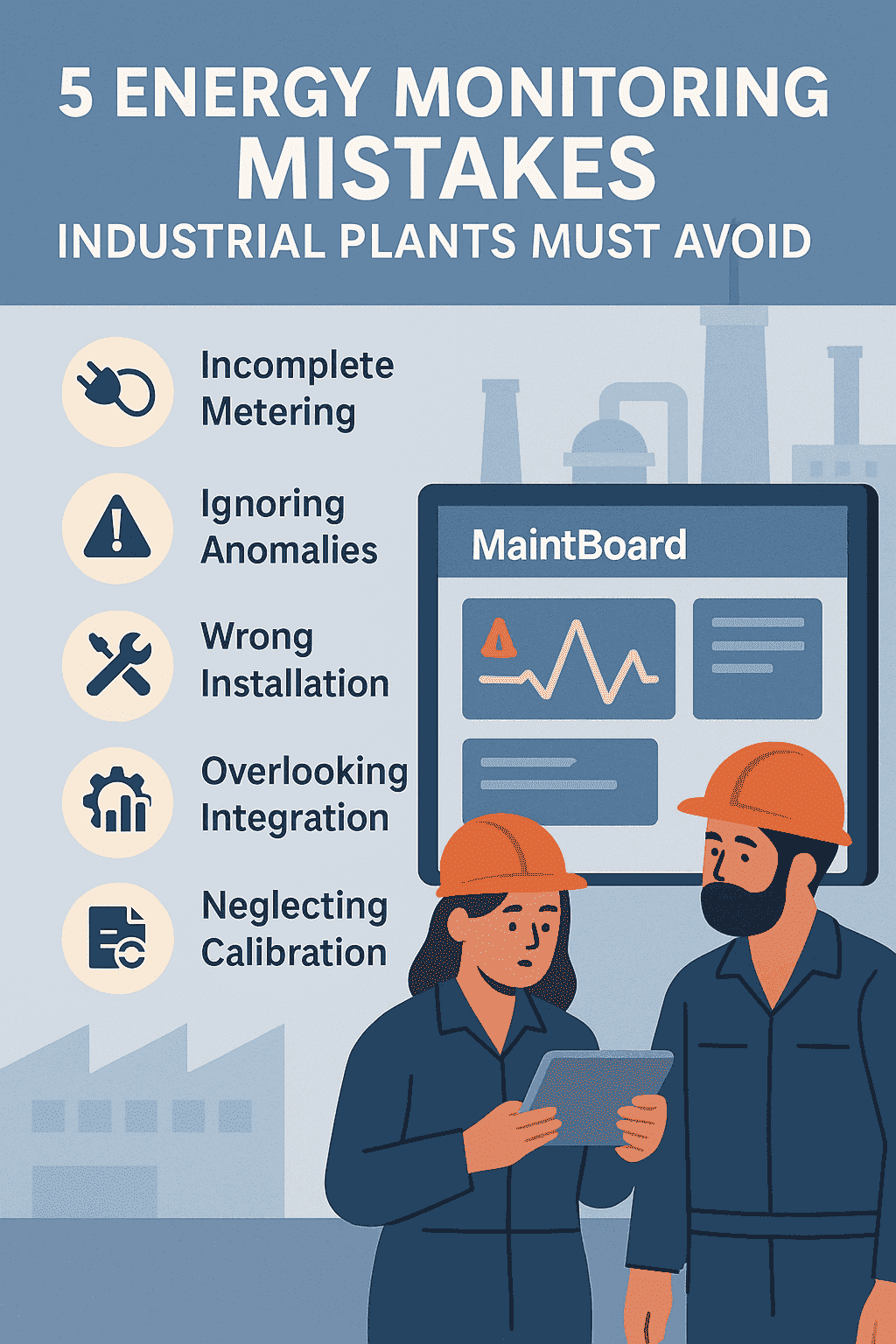
Energy monitoring can help industrial plants reduce waste, improve equipment reliability, and control operating cost. But many energy monitoring projects fail because they stop at dashboards.
A meter reading by itself does not save energy. A chart by itself does not fix compressed air leakage, motor overload, idle running, poor insulation, pump inefficiency, or equipment deterioration.
Energy monitoring becomes valuable when abnormal energy use is connected to maintenance action.
Mistake 1: Monitoring energy without asset context
A plant may know total energy consumption, but not which asset, line, utility, or area is responsible.
This creates vague discussions:
- “Energy is high this month.”
- “Compressor power increased.”
- “Chiller consumption is abnormal.”
- “Line 2 seems inefficient.”
Without asset context, the maintenance team cannot act clearly.
Energy data should be linked to:
- Asset
- Location
- Line
- Utility system
- Shift
- Production state
- Downtime state
- Maintenance history
A practical asset management software system helps connect equipment history with energy behavior.
Mistake 2: Treating energy monitoring as only an electrical team topic
Energy waste is not only an electrical issue.
Maintenance-related causes include:
- Air leakage
- Steam leakage
- Poor lubrication
- Bearing wear
- Clogged filters
- Chiller fouling
- Pump inefficiency
- Motor misalignment
- Conveyor friction
- Idle running
- Poor insulation
- Faulty sensors
- Wrong operating practice
Electrical teams may measure the consumption, but maintenance and operations teams often need to remove the cause.
Mistake 3: Collecting data but not creating work orders
This is the biggest failure.
The dashboard shows abnormal consumption. Everyone agrees it is a problem. Then nothing happens.
A useful process should convert abnormal energy findings into maintenance work:
- Abnormal energy pattern is detected.
- Supervisor reviews the asset or area.
- Work order is created.
- Technician inspects the likely cause.
- Parts or corrective action are planned.
- Repair is completed.
- Energy trend is reviewed after closure.
A work order management software workflow turns energy insight into accountable action.
Mistake 4: Ignoring downtime energy consumption
A stopped machine may still consume energy.
Examples:
- Conveyor idle running
- Compressor running during no production
- Pumps circulating unnecessarily
- HVAC running in empty areas
- Chiller running without load
- Lighting left on
- Utilities running during maintenance delay
Downtime is not only lost production. It can also be wasted energy.
A strong energy monitoring software approach should help teams see where energy is consumed during idle, stopped, or low-load conditions.
Mistake 5: Not comparing energy with maintenance history
Energy changes can be an early sign of equipment problems.
Examples:
- Motor current increases before failure.
- Compressor energy rises due to air leakage.
- Pump power changes due to blockage or wear.
- Chiller energy rises due to fouling.
- HVAC consumption increases due to filter clogging.
- Conveyor power rises due to mechanical friction.
If energy data is not compared with asset history, the team may miss early warning signs.
A predictive maintenance software mindset uses condition signals to plan work before failure.
Mistake 6: No ownership for abnormal readings
Energy alerts fail when nobody owns them.
Every abnormal reading should answer:
- Who reviews it?
- Who decides whether it is maintenance, operations, or process-related?
- Who creates the work order?
- Who completes the corrective action?
- Who verifies improvement?
Without ownership, alerts become noise.
Mistake 7: Measuring too much too soon
Some plants install many meters but do not define the operating questions.
Start with high-value areas:
- Compressors
- Chillers
- Boilers
- Pumps
- HVAC systems
- Major production lines
- Cold rooms
- High-load motors
- Utilities
Then define what action should happen when readings are abnormal.
What good energy monitoring should support
A practical energy monitoring program should help teams:
- Track energy by asset, line, area, and utility
- Identify abnormal consumption
- Compare energy with downtime
- Create work orders for investigation
- Link findings to asset history
- Track corrective actions
- Verify improvement after repair
- Report savings and avoided waste
Energy monitoring should not sit outside maintenance. It should feed maintenance action.
Bottom line
Industrial energy monitoring fails when it only produces charts. It succeeds when abnormal energy use leads to investigation, work orders, corrective action, and verified improvement.
MaintBoard helps maintenance teams connect energy-related observations with assets, work orders, downtime, preventive maintenance, corrective actions, and reports so plants can move from visibility to execution.
Frequently asked questions
- How does linking energy meters to assets improve maintenance?
It gives you asset-level insights, helping identify underperforming machines, compare similar equipment, and trigger work orders based on real-time energy usage.
- Why isn’t tracking total kWh enough for energy monitoring?
Total kWh doesn’t reveal where energy is wasted. Tracking KPIs like idle energy or kWh per work order helps pinpoint inefficiencies and take corrective action.
- How does downtime affect energy consumption?
Equipment still draws power during downtime. If unmonitored, this idle energy waste adds hidden costs and skews your maintenance efficiency metrics.
- Is energy monitoring a one-time setup?
No, thresholds and baselines must evolve with equipment and process changes. Continuous review ensures your monitoring stays relevant and leads to real savings.
- Why should technicians be trained on energy data?
If technicians ignore energy anomalies, they miss early warning signs. Training them ensures data drives action, reducing waste and preventing breakdowns.
- How can MaintBoard help with energy monitoring?
MaintBoard links meters to assets, tracks energy KPIs, monitors idle losses, and triggers work orders from anomalies—turning your energy data into measurable action.